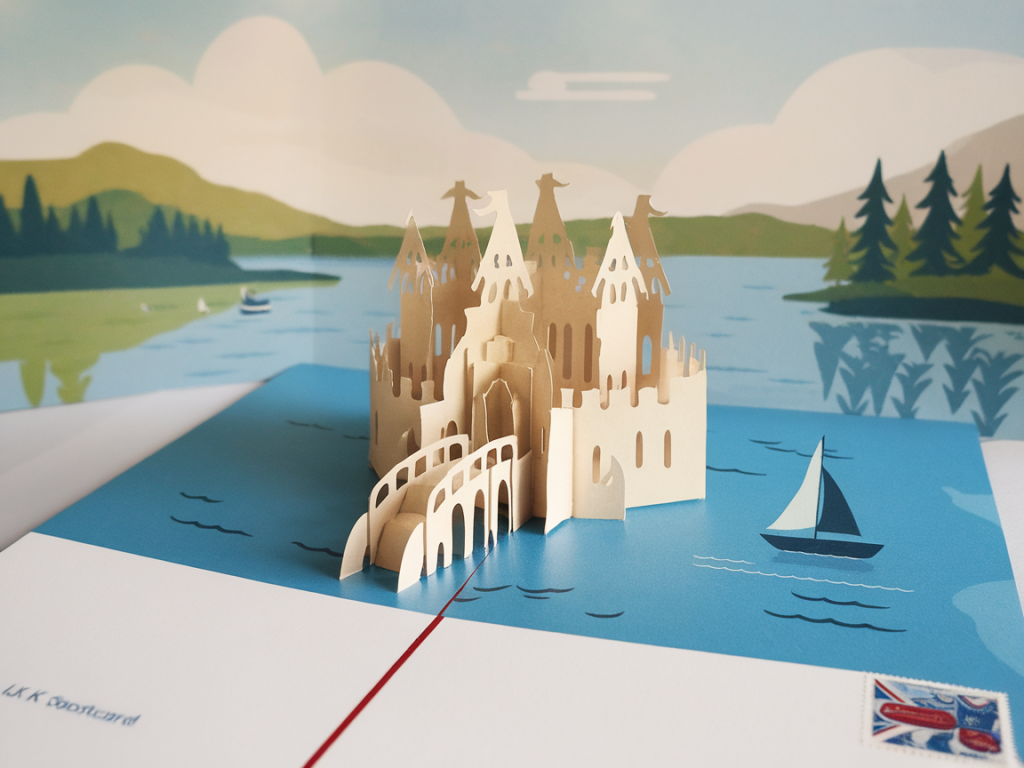
I love a small, secret moment in the mail — something that looks ordinary from the outside but opens to reveal a little bit of mischief. In this piece I’ll walk you through how I design an instant pop-up postcard that conceals a surprise illustration and will still behave like a regular postcard in the post. I’ll share measurements, templates you can reproduce, materials I trust, and a few troubleshooting tips from my own experiments in the studio.
Why A6 postcard size (and postage basics)
When I make pop-up postcards I use A6 (105 × 148 mm). It’s a handy size: small enough to feel intimate, large enough to show a clear illustration, and easy to slide into a standard letter. Most importantly, an A6 postcard gives you plenty of room for a concealed pop-up while staying well within typical Royal Mail postcard dimensions and the area where stamps are normally affixed (top-right corner).
Two quick postal notes I always check before sending handmade mail:
If in doubt, pop into your local post office with a test piece — they’ll be able to tell you if it needs more postage.
Materials and tools
| Materials | Why I use it |
| 300–350 gsm cardstock (A6 sheet) | Stiff enough to mail without an envelope, holds pop-up mechanisms |
| Lightweight paper for pop-up elements (90–120 gsm) | Easier to fold and glue than heavy cardstock |
| PVA glue or double-sided tape | Strong bond and a flat finish |
| Craft knife & metal ruler | Clean cuts and precise folds |
| Scoring tool or bone folder | Crisp folds for reliable popping |
| Pencil, eraser, fine black pen | Sketching and outlining |
| Watercolour / gouache / markers | Illustration media of choice |
Basic structure: an instant pop-up with a concealed flap
The idea is simple: the postcard is a folded card (A6 folded from A5 or two A6 panels) that opens to a pop-up element. The outside looks like a normal postcard; the pop-up sits behind a concealed flap or window so the surprise is hidden until the recipient fully opens the card.
My favourite approach uses a single A5 sheet folded in half to create two A6 panels:
Step-by-step build (templates you can use)
Here’s a reproducible method that’s worked well for me. Measurements assume an A5 base folded to A6 — adapt to your preferred orientation.
Designing the concealed illustration
I often design the visible outside of the postcard with a hint — an eyebrow-raising line or a partial drawing — that promises something more. The concealed illustration can be:
Keep the hidden piece under 1.5 mm thickness where the flap covers it; multiple layers of heavyweight paint or glued elements can make postable mail require additional postage. Watercolour, gouache gradients, or thin marker layers work beautifully.
Finishing touches and postal-proofing
Before you send your creation I always do a few checks:
Variations and creative prompts
For tools, I love using a metal ruler and Olfa precision cutter for clean edges, and Pritt Stick or UHU double-sided tape when I need faster adhesion with minimal warping. For painting, Winsor & Newton Cotman watercolours or Holbein gouache give reliable, vivid colour without going too thick.
Troubleshooting common problems
If your pop-up doesn’t lie flat:
If the postcard bulges and risks extra postage:
Making a small, delightfully secretive pop-up postcard is an exercise in constraints: you must balance whimsy with postal practicality. That limit is precisely what I love — it makes every fold, material choice and little trick feel considered. If you try this, I’d love to see what you make: tag me or drop a picture in the comments on the blog at https://www.maxthemagician.co.uk — I’m always curious to see how other makers solve the same tiny problems.