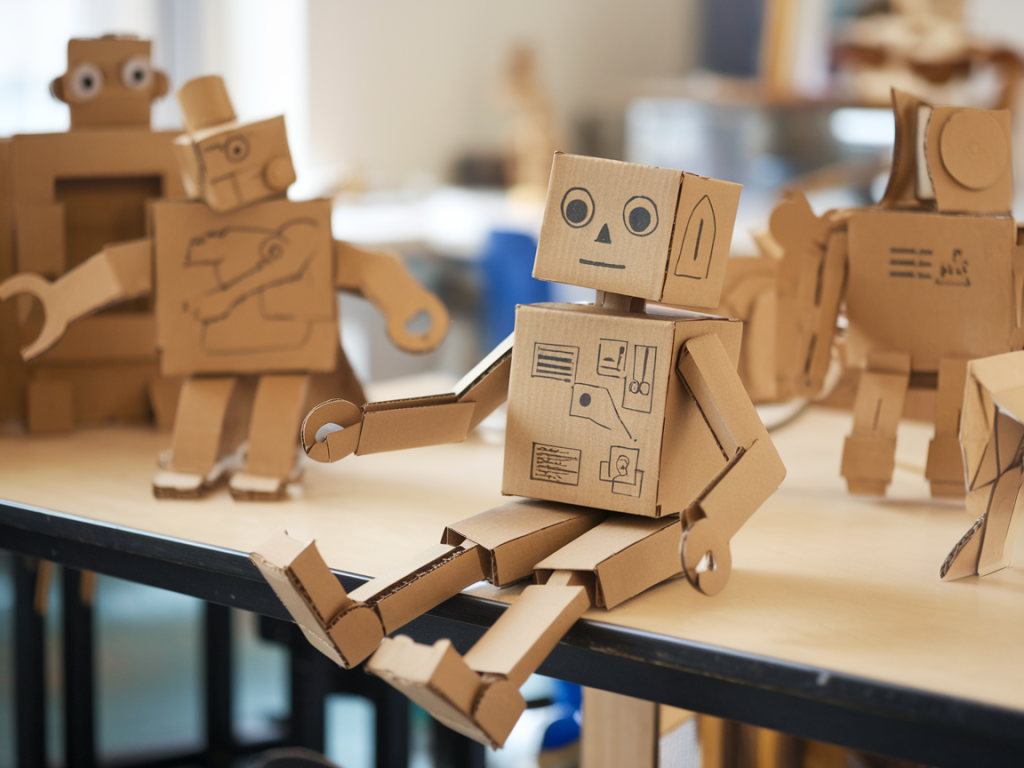
I teach a lot of short, pop-up workshops where people of wildly different ages and abilities come together around one tiny, brilliant problem: how to make a little cardboard automaton that moves. Ten minutes sounds impossibly brief, but with a little planning you can design a session that feels playful, productive and genuinely magical for everyone involved. Below I share the three fail-safe steps I use every time I teach a mixed-age group—plus timing, materials, accessibility tips and quick troubleshooting so you can run your own 10-minute automaton lesson with confidence.
Why 10 minutes works
Ten minutes forces simplicity. It strips away perfectionism and asks participants to make a clear, physical choice: one mechanism, one motion, one story. For mixed-age groups this brevity levels the playing field—children and adults can complete something in a single sitting, which keeps motivation high and attention focused. I design the activity so every participant finishes with a working automaton or a clear next step to take home.
The three fail-safe steps
These are the bones of the lesson. Follow them in sequence and you’ll be surprised how reliably they produce delight.
Step 1 — Offer one simple mechanism and two variations
Choose a single, robust mechanism that’s easy to demonstrate: a cam-driven lift, a crank-slider, or a simple hinge with a return spring (a folded card or rubber band). I prefer a cam made from a circle of cardboard with an off-centre hole because it translates rotary motion into charming up-and-down action, and it can be made without any tools beyond a hole punch or awl.
Give exactly two visual variations people can choose from—this reduces decision fatigue. For example:
- Variation A: a character that nods (small cam, shallow rise)
- Variation B: a jumping object (larger cam, deeper rise)
These two choices let younger makers pick something cute while older participants can tweak proportions for a more complex motion.
Step 2 — Pre-cut kits and guided assembly
You cannot waste minute one of ten on heavy cutting. Pre-cutting key parts is the secret ingredient to a fast, fair workshop. Prepare kits that include:
- 3–4 cardboard pieces: base, cam wheel, arm, and a character/shape
- a wooden skewer or BBQ stick (axle)
- a split pin (brad) or elastic band for simple pivots
- a small square of foam or folded card for a cam follower
- a length of tape and a glue stick
- a marker for decoration
Hand out one kit per participant. Demonstrate the assembly in three actions: attach the cam to the axle, slot the axle through the base, and fix the arm to the cam. Show the motion slowly, then speed up. Ask participants to copy your steps—this choreography keeps hands busy and minds aligned.
Step 3 — Encourage one small, personal tweak
Once a basic movement is working, invite makers to personalize it in one small way. This is where storytelling and surprise enter. Prompts that work quickly:
- “Change the character’s expression.”
- “Add a tiny prop that the arm interacts with.”
- “Make the motion faster or slower—what changes?”
Keep the tweak limited to one action so everyone finishes. I circulate during this moment, offering single-sentence suggestions that nudge but don’t take over: “If it’s jerky, switch to a bigger cam,” or “Tape a small paper spring behind the arm for a bouncier return.”
Timing breakdown (10 minutes)
| 0:00–0:45 | Welcome, brief explanation, show finished example |
| 0:45–2:30 | Introduce mechanism and two variations, demonstrate assembly slowly |
| 2:30–6:00 | Hands-on assembly (pre-cut kits). Circulate with quick tips |
| 6:00–8:30 | Personal tweak and decoration |
| 8:30–10:00 | Share one highlight aloud or swap kits to test variations |
Materials, prep and accessibility
Good prep is generous teaching. Here’s a practical kit list and accessibility notes:
- Cardboard: thin single-wall from cereal boxes works well—easy to fold and punch.
- Tools: hole punch, craft knife (for your prep only), scissors, glue sticks, masking tape.
- Fasteners: small wooden skewers, split pins (brads) or short lengths of straw for axles.
- Extras: pre-drawn faces, stickers, markers, and small foam pads for cam followers.
Accessibility tips:
- Pre-assemble the trickiest part for anyone with limited dexterity (I keep a few “almost finished” kits).
- Use thicker axles (straw) for those with weaker fine motor control.
- Pair younger makers with older participants or volunteers to encourage collaboration.
- Offer verbal descriptions and slow demonstrations for visually impaired participants; use high-contrast tape to mark orientation of parts.
Common problems and quick fixes
When things go wrong, your single-sentence fix saves time.
- Automaton sticks or jams: Loosen the axle slightly or sand the contact edge; add a small foam spacer so parts don’t rub.
- No movement: Check the cam offset—if it sits concentric, the motion disappears. Move the hole off-centre a few millimetres.
- Motion is weak: Use a larger cam or shorten the arm for more visible movement.
- Arm swings unpredictably: Add a small paper spring behind it (folded card) to guide the return.
Ways to adapt and extend
The beauty of this compact lesson is how naturally it scales.
- For older kids or crafty adults, turn the cam into a decorated disc and add a second arm for compound motion.
- For schools, extend it into a 30-minute session with sketchbook design time, testing different cam shapes (egg-shaped, elliptical) and documenting the results.
- Create a collaborative “chain automaton” where each 10-minute maker adds a segment—this works brilliantly at festivals.
Sharing and celebration
Take a few photos, but also ask people to show their automaton in motion to a neighbour. A quick verbal share—“My automaton is a sleepy cat that nods!”—makes the moment social and cements the sense of achievement. I often invite makers to post images to the Maxthemagician Co Instagram or website (https://www.maxthemagician.co.uk) with a specific hashtag so we can celebrate experiments together.
If you try this model, start with a small group and one mechanism. You’ll learn how to read attention spans and which little nudges produce the biggest smiles. Ten minutes can be enough to catch wonder—especially when the activity is designed to be fast, forgiving and incandescently simple.