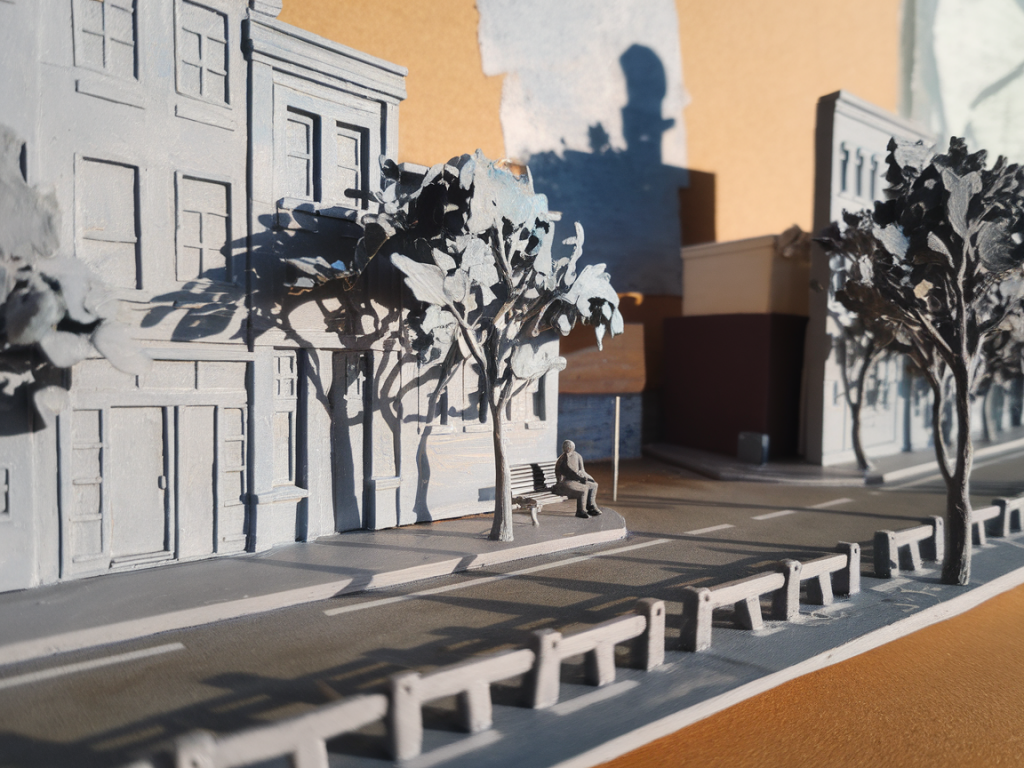
I love the tiny, quiet moments when a small object suddenly seems larger than life. Over the years I’ve learned a handful of tricks to make miniature sculptures read as deeper and more three-dimensional than their actual thickness — and one of my favourite combinations is painted shadow with foamcore layers. It’s an inexpensive, fast way to fake depth that works for whimsical characters, diorama nooks, and tiny stage-like scenes. Below I’ll share my process, materials, and troubleshooting tips so you can try it at home.
Why painted shadows + foamcore?
When you sculpt on a very small scale, you’re fighting the limitations of material thickness and the way our eyes read cues like cast shadows, occlusion and overlap. Foamcore gives you crisp, structural layers that read as distinct planes. Painted shadows provide the soft, subtle gradients that the eye expects from curved forms or recesses. Together they convince the brain that a flat plane is actually a deep space.
It’s also playful and forgiving: you can cut, test, repaint and re-layer until the effect sings. I often work with what’s on hand — inexpensive foamcore, leftover gouache, or acrylics — and I love how accessible this method is.
What you’ll need
| Material | Notes |
| Foamcore (3mm–5mm) | Standard art-store foamboard; thicker for more physical depth |
| Acrylic or gouache paint | Gouache is lovely for velvety, matte shadows; acrylics dry faster and are durable |
| Soft synthetic brushes | Small round and flat brushes for blending |
| Hobby knife (X-Acto) | Sharp blade for clean cuts |
| Cutting mat | Protect surfaces and get accurate cuts |
| Archival glue or PVA | For secure adhesion between foamcore layers |
| Light source | Small desk lamp helps you decide shadow direction |
Prep and planning
I like to sketch the composition in my sketchbook first: where will the foreground, middle ground and background sit? Which elements will cast shadows on others? Decide a consistent imaginary light direction — usually a 45-degree angle from the upper-left or upper-right feels natural. Once you lock that in you can plan where painted shadows should fall to match the physical layering.
Cut all your foamcore shapes a little larger than you think you’ll need. It’s easy to trim down; building up is harder. Think in planes: a backboard (background), one or more middle layers, and a foreground siting that might include tiny props or characters.
Painting shadows: technique and colour
The goal is to mimic how light wraps and how surfaces block light. Here are practical tips I use every time:
When I’m painting tiny cast shadows on foamcore, I often prime the surface with a very thin wash of neutral grey so that subsequent shadow layers sit harmoniously. This also prevents the foamcore from soaking up paint unevenly.
Layering and assembly
With your painted shadow shapes ready, you can begin layering. The tactile separation between planes is crucial. I use strips of foamcore offcuts as spacers when gluing layers together — this maintains a consistent gap and allows for a believable separation that catch real light.
Registering painted shadows to real cast shadows
One of the most convincing tricks is aligning painted shadows with the real shadows cast by the physical layers under your chosen light. When the painted shadow on a middle plane continues visually into the real shadow cast by a foreground paper cutout, the eye will assume uninterrupted depth. To achieve this:
Troubleshooting common problems
Here are issues I run into and how I solve them:
Finishing touches and presentation
Small details make the scene feel lived-in: a speck of reflected light, a faint dust of paint on the base, or a tiny painted texture on the background wall. Consider mounting the work in a shallow box frame or under a glass dome to control viewing angle and preserve the delicate layers. When photographing for your blog or portfolio, keep the camera at the same angle you designed for — viewers will see the illusion most strongly from that point of view.
If you try this technique, I’d love to see what you make — tag me or drop a photo in the comments at maxthemagician.co.uk. Small experiments often become bigger ideas; the happiest surprises in my studio came from a test that I almost threw away. Happy making — and may your tiny sculptures feel wonderfully larger than life.