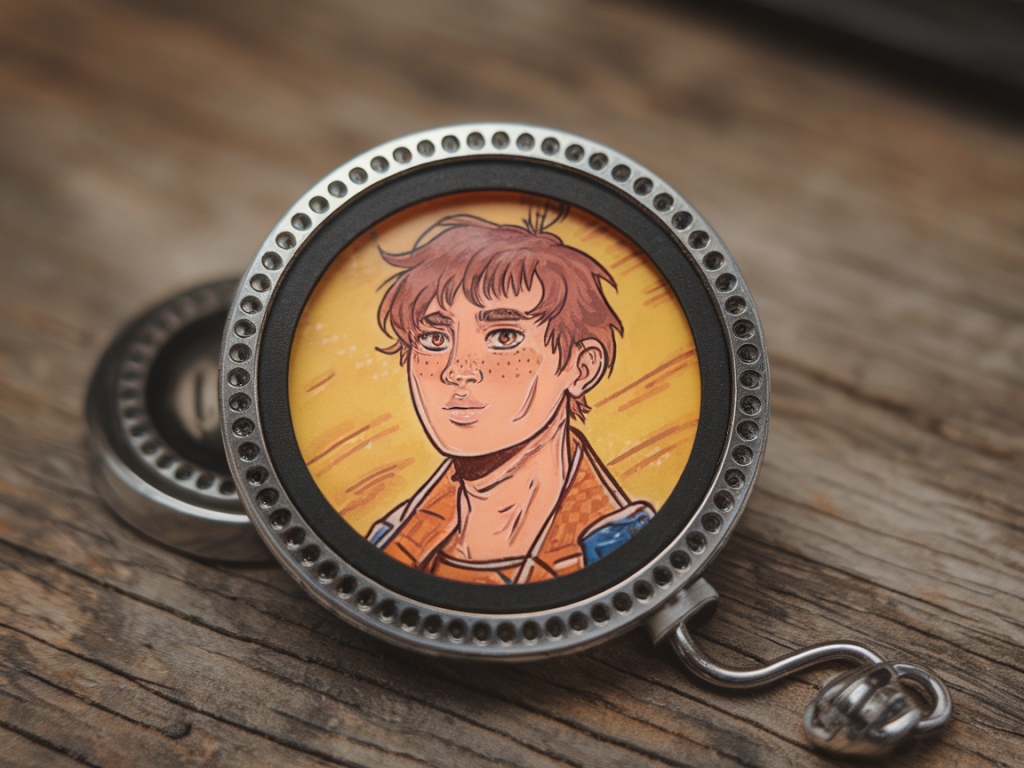
I love tiny devices that make an idea feel like a small miracle. A pocket-sized thaumatrope is exactly that: two simple images that seem to animate when spun. It’s one of the oldest optical toys — Victorian parlour entertainment — and it’s a brilliant little project for anyone who likes drawing, tinkering, or teaching the basics of persistence of vision. Below I’ll show you how I make a durable, delightful thaumatrope that brings my own character sketches to life. You can make one in twenty minutes, or spend an afternoon making a whole cast of moving personalities.
What is a thaumatrope and why it still feels magical
A thaumatrope is a disc (or card) with different images on each side. When spun quickly, the two images merge in our perception — for example, a bird on one side and a cage on the other appear as a bird in a cage. It’s a simple demonstration of persistence of vision: our eyes retain an image for a tenth of a second or so, which lets separate frames fuse into a single perception. I find the charm of a thaumatrope is the moment of surprise — the blink when two drawings become one animated idea.
Materials
Here’s what I usually have at hand. You don’t need fancy kit — humble materials are my favourite.
| Paper/card | 200–300 gsm cartridge paper or heavy card — sturdy enough to take glue and spinning. |
| Drawing tools | Pencils, fineliners (I love Sakura Pigma Micron), coloured pencils, watercolour or gouache for small washes. |
| Cutting | Scissors or a craft knife and a cutting mat. |
| Hole punch | Single hole punch or awl for making string holes. |
| String/elastic | Strong thread, embroidery floss, or thin elastic band; wooden skewers for handles. |
| Adhesive | PVA glue, double-sided tape, or glue stick. I sometimes use spray mount for a seamless finish. |
| Optional | Laminator or clear packing tape for durability; printer if you prefer to print drawings (I use an Epson EcoTank). |
How I plan the character animations
Thaumatropes work best when the two images combine into a single readable idea. I usually sketch small thumbnails first. Ask yourself: what two elements can merge? A cat + a fishbowl, a moon + an owl, a character with closed eyes + the same character with open eyes to make a blink. Keep compositions simple and bold — large, high-contrast shapes read better when spinning.
When drawing characters, I think in silhouettes. If you’re unsure, reduce your drawing to a solid black shape and test the readability. You can add details once the basic motion works.
Step-by-step: Make your thaumatrope
- Step 1 — Create two matching templates: Cut two circles (or cards) of the same size — 6–8 cm diameter is a pleasing pocket size. Trace one onto a scrap to use as a guide when positioning your drawings.
- Step 2 — Draw in reverse relationship: On one disc draw the character; on the other disc draw the object that will merge with the character (e.g. a hat, wings, cage, or open/closed eyes). Keep the central axis consistent — where the two images will meet when spun. Use faint pencil first, then ink or colour.
- Step 3 — Add registration marks: Lightly mark the top and bottom of each disc so you can align them later. Accurate alignment makes the illusion crisp.
- Step 4 — Laminate or reinforce: If you want durability, sandwich both discs with thin card or laminate them with clear tape, trimming the edges neatly. This helps prevent warping when you attach string.
- Step 5 — Join the discs: You can either glue the two discs back-to-back (images facing outwards) leaving a small overlap, or mount each image on a stiff backing and attach through the centre with a brad. If gluing, place a small dab of PVA in the centre so the disc spins freely; too much glue can make it stiff.
- Step 6 — Punch holes for string: If you prefer the classic handle method, punch two holes near the edges, directly opposite each other. Thread a loop of string through, tie, and attach to straws or a wooden skewer to hold. Alternatively, make two parallel holes and feed a thicker elastic band; when you twist and release the elastic, the disc spins.
- Step 7 — Play and tweak: Spin the thaumatrope between your palms, or flick the string with your thumb. If the image seems offset, unglue gently and re-align using your registration marks. If it wobbles, check that both discs are exactly the same size and weight.
Troubleshooting FAQ
Why does my thaumatrope appear blurred? Often the images aren’t aligned, or the drawings have too many small details. Simplify the shapes and re-check alignment using the registration marks.
My disc doesn’t spin smoothly — it tilts — what can I do? Check that both discs are evenly cut and not bent. If you glued them, the glue may have dried unevenly; sanding the edges lightly or mounting on a single flat backing can help. Using a brad through the centre, with a tiny spacer (a small washer or a blob of hot glue that lets the disc turn) can create a freer rotation.
Can kids make this? Absolutely. For young children I recommend pre-cut discs, thicker elastic or a plastic toy handle, wash-safe markers, and supervision when using hole punches or scissors. It’s a lovely classroom project to teach early animation and observation.
Variations and playful extensions
- Flipbook fusion: Make a series of three thaumatropes with incremental changes to create a longer sequence when you flick each in turn.
- Motorised thaumatrope: Attach the disc to a small motor (like a 3V hobby motor) and power it with a coin cell for continuous spinning — perfect for a shelf display.
- Double exposure: Use translucent vellum for one side so you can layer textures — I sometimes use a watercolour wash on vellum for soft skies behind a silhouette.
- Interactive storytelling set: Make a pocket collection of characters and props with labelled pockets. Swap elements to invent new animations.
How I document and share the process
I like photographing the stages with a simple phone camera and a white lightbox (you can DIY one with a cardboard box and tracing paper). If you want to show motion online, shoot a short video at 120 fps on a smartphone for clear slow-motion, or use a stop-motion app to demonstrate the before/after flip. On my blog I usually pair the how-to with a short visual story about the character — it’s fun to give your thaumatrope a personality beyond the trick.
Materials I recommend
For pens, Sakura Pigma Micron or Uni Pin are reliable for inkwork that won’t bleed when laminated. For colour I often use Faber-Castell Polychromos pencils for saturated, blendable tone. If you plan to print templates, an Epson EcoTank printer gives excellent results and economical ink usage for experimental printing.
Making a thaumatrope is one of those projects that rewards both the casual maker and the meticulous crafter. It’s fast enough to make on a whim, generous enough to layer with storytelling, and endlessly tweakable. Try making two versions of the same character — one tiny and one slightly altered — and watch how a simple spin makes them feel alive. If you make one, tag me or drop a photo on the blog — I’m always curious to see what surprise people pull into being from a couple of circles of paper.