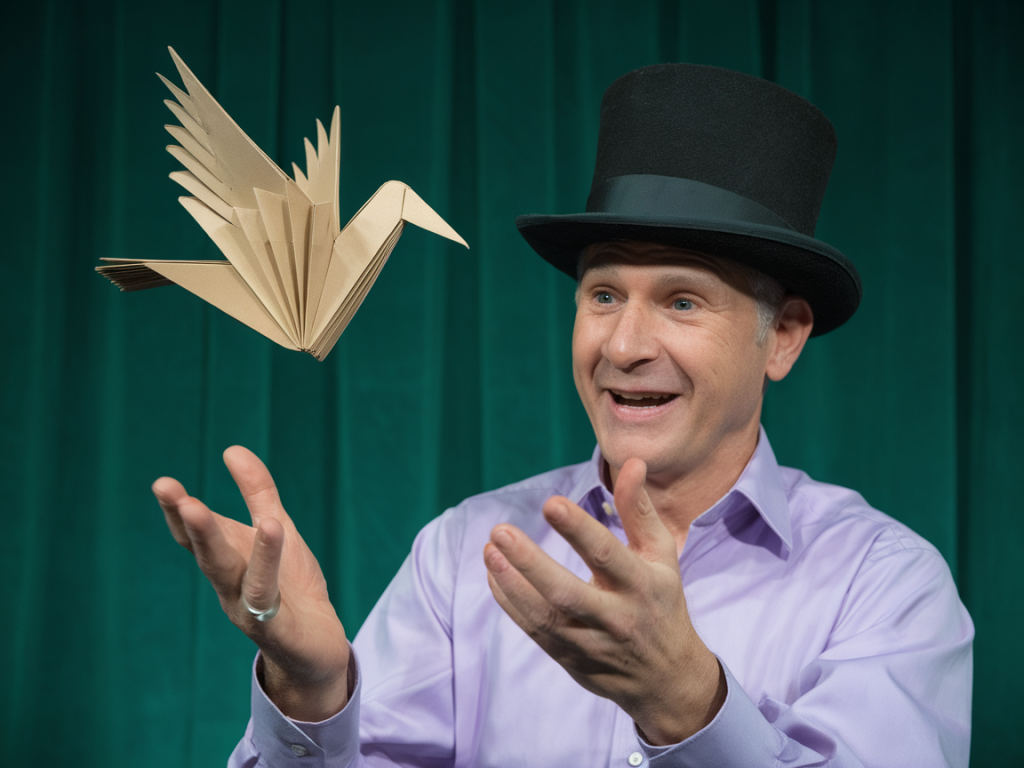
I love a simple trick that looks like magic, and this little paper automaton — a flipping bird that needs no glue — is one of my favourite quick projects to teach and to make when I want an instant charm hit from humble materials. It’s the kind of thing I sketch in my notebook between larger pieces: quick to prototype, satisfying to wind up, and endlessly tweakable. Here I’ll walk you through how I build it, why the mechanism works, and a few playful variations to try.
Why make a glue-free paper automaton?
Working without glue keeps the project portable, tidy and forgiving. The whole thing is held together by clever folding, tension and simple fastenings so you can assemble it on a kitchen table or a train seat without worrying about drying time. It’s also a lovely exercise in thinking mechanically: how can paper, thread and a few split pins (brads) be combined to create motion? That constraint often opens up new creative possibilities.
Materials
For this build I favour accessible, inexpensive supplies — many you might already have in your studio. I’ll mention my favourite brands where it helps, but none are essential.
- Cardstock (300–350 gsm) for the bird and base — sturdy enough to hold shape but foldable. I like Canson or Strathmore bristol.
- Light paper (90–120 gsm) for linkages and wings.
- Two split pins (brads) — brass or steel.
- Strong thread or thin fishing line (e.g., 0.15–0.2 mm) for a pull string.
- Small wooden dowel or straw (6–8 mm diameter) to act as a cam / pivot.
- Scissors and a craft knife.
- Ruler, pencil and compass.
- Optional: a hole punch, a scrap of rubber band (for return tension), coloured pens or gouache to decorate.
How it works (the simple mechanics)
The flipping action comes from a cam-and-linkage system. The dowel serves as a rotating cam; a paper crank attached to it converts rotation into an up-and-down motion through a short paper linkage, which flips the bird’s body. A return mechanism (either gravity, a rubber band or a slightly offset pivot) brings the bird back to its resting position so the flip can be repeated.
Cutting and preparing parts
Start by cutting a few basic pieces. I usually make a quick template in my sketchbook first, but you can cut as you go.
- Base: a rectangle of cardstock roughly 120 x 80 mm.
- Bird body: a roughly teardrop-shaped piece about 70 mm long and 35 mm tall. Score the body gently where the wing will fold.
- Wing/flip plate: a strip of lightweight paper 40 x 20 mm. This will be the piece that actually moves and pushes the body to flip.
- Crank arm: a strip of cardstock 40 x 12 mm with a hole near one end to attach to the cam/dowel.
- Linkage strip: lightweight paper about 30 x 8 mm with holes at each end for the brads.
- Cam / axle: a short dowel (or a thick straw) about 60 mm long. If you don’t have a dowel, roll a tight tube of cardstock and tape it — I sometimes use the centre of a paper towel roll for larger experiments.
| Part | Typical size | Material |
|---|---|---|
| Base | 120 x 80 mm | 300 gsm cardstock |
| Bird body | 70 x 35 mm | 300 gsm cardstock |
| Wing/flip plate | 40 x 20 mm | 90–120 gsm paper |
| Crank arm | 40 x 12 mm | cardstock |
| Linkage | 30 x 8 mm | light paper |
Assembly — step by step
Work patiently; the trick is alignment. If parts are slightly off, the mechanism will stick. I often make several prototypes to fine-tune the hole positions.
- Mark the centreline of your base. This helps position the cam and bird so the motion is centered.
- Create two small holes in the base to hold the dowel. The dowel should sit across the base, roughly 20 mm from one short edge. If using a straw, wedge it so it can rotate but is held in place.
- Attach the crank arm to the dowel. Pierce a hole near one end of the crank arm and slide it onto the dowel so it can rotate with the cam. Secure it by flattening the end of the dowel slightly or by tying with thread — we’re still avoiding glue. The crank should sit at a slight offset from the dowel’s centre (this eccentricity is your cam).
- Attach one end of the paper linkage to the crank arm using a split pin through both parts. The pin should allow the linkage to swivel freely.
- On the other end of the linkage, use the second split pin to attach to the flip plate (the lightweight wing). Make sure the flip plate can swing under the bird body.
- Position the bird body on the base above the flip plate. The flip plate should push the bird’s tail or underside just enough to flip it forward when the crank rotates. Use a small folded tab tucked under the bird as a pivot point — a scored fold in the bird body makes a nice resting hinge.
- Test the motion by rotating the dowel with your finger. Adjust hole positions and the length of the linkage until the flip is dramatic and then returns cleanly.
- If the bird doesn’t return, add a rubber-band loop from the bird’s tail to the base to provide a gentle pull-back, or bias the bird’s pivot slightly so gravity does the work.
Troubleshooting and tuning
Here are common problems and how I solve them:
- Sticking or jamming: Check that holes are not too tight. Enlarge slightly with a craft knife or punch so the brads rotate freely. Reduce friction by using lighter paper for moving parts.
- Flip too weak: Increase the offset on the crank (more eccentricity) or shorten the linkage slightly so it gives a greater shove.
- Flip too violent: Lengthen the linkage or reduce the crank offset. You can also add a tiny paper dam under the bird to soften the landing.
- Uneven motion: Ensure the dowel is straight and the crank arm doesn’t wobble; secure the axle points on the base evenly.
Decorating and storytelling
Once the mechanics are happy, I treat the bird like a little character. Paint a face, add collage feathers, or draw a sequined wing. I like using gouache for bright flat colour and a white gel pen for tiny highlights. You can also create a small scene on the base — a branch drawn in ink, a printed paper sky, or a tiny paper audience of cheering mice.
Variations to try
Play with scale, materials and motion. A few of my favourite variations:
- Multiple birds: Mount two or three cams on the same axle, each timed differently so birds flip in sequence. Great for a small automaton parade.
- Reverse action: Flip the crank so the bird dives instead of flipping. It changes the whole character.
- Wind-up mechanism: Replace the hand-turned dowel with a simple rubber-band motor for continuous flipping (tie a rubber band between the dowel and a fixed post, twist and let go).
- Mixed materials: Try thin balsa wood for a sturdier wing, or use recycled packaging for a textured body.
I keep a little box of these tiny experiments in my studio. They’re perfect quick gifts, workshop demos or a cheerful addition to a desk. Making a no-glue automaton slows you down just enough to notice the delightful physics of paper and tension — and the result is something that feels alive, even if it’s only a few centimetres tall. If you make one, I’d love to see your photos and hear what you named your bird. Share them on the site or tag @maxthemagician on Instagram — I love the little variations people come up with.