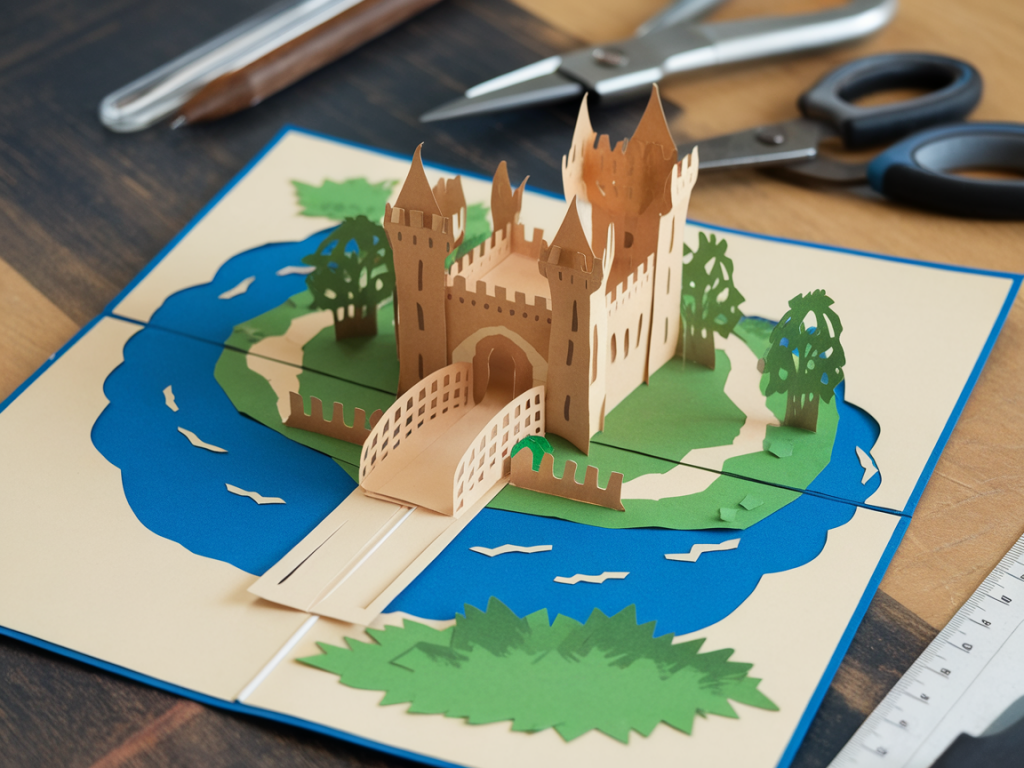
Turn a single sheet of paper into a pop-up scene in under 20 minutes

Turn a single sheet of paper into a pop-up scene in under 20 minutes

I love small, quick projects that still feel like miniature acts of magic. This pop-up scene uses a single sheet of paper and can be made in under 20 minutes — perfect for an afternoon break, a handmade note, or a tiny theatrical surprise tucked into a card. You don’t need fancy tools: just a sheet of paper, a pair of scissors or craft knife, a ruler, and a little patience. Below I’ll walk you through my favourite simple structure, explain why it works, and share a few playful variations you can try.

What you’ll need

Gather these basic materials — most are household items:

  • A4 or letter-size paper (cardstock 160–240gsm works best if you want sturdiness)
  • Scissors or a craft knife (X-Acto)
  • Ruler and pencil
  • Double-sided tape or glue stick
  • Optional: markers, watercolour, patterned paper, stamps, or small stickers for decoration
  • Why a single sheet?

    I love the constraint of using one sheet because it forces you to think about positive and negative space. The pop-up portion and the background are created from the same plane, so the illusion of depth is more convincing and the finished piece feels unified. It’s also fast: fewer pieces to cut, fewer things to glue, and everything folds back down flat so it’s easy to post or slip into a journal.

    Quick time plan

    Step Estimated time
    Prep & mark guidelines 2–3 minutes
    Cutting and folding pop-up elements 6–8 minutes
    Decorating & attaching details 6–8 minutes
    Total ~15–20 minutes

    Step-by-step: a simple middle-slit pop-up scene

    This is the structure I reach for when I want speed and reliability. It makes a central stand that pops up when the page opens — perfect for a character, tree, or building.

  • Fold your sheet in half widthwise (hot dog style) so the short edges meet. Crease firmly with your fingernail or a bone folder.
  • Decide where the pop-up will sit — I usually place it in the centre, about 5–7 cm from the fold (2–3 inches). Using a ruler and pencil, draw two parallel vertical lines on the folded edge. These lines will be the sides of the slit; make them the height you want your pop-up (4–6 cm is a good range).
  • Cut between the two lines with scissors or a craft knife. Keep your cut neat — this is the foundation of the mechanism.
  • Open the paper slowly. You’ll see a rectangular tab formed by the cut. With your finger, push that tab inward so the centre folds toward you and the top of the tab tilts into the interior of the page. Crease the reverse edge so it pops forward when the card opens.
  • Close and reopen the card to set the creases firmly — the tab should fold forward and sit perpendicular when the sheet is open.
  • Now decorate the tab and the surrounding page. For a little scene I often cut a silhouette — a tiny house, a magician’s top hat, or a friendly character — from a contrasting scrap of paper and glue it to the forward-face of the tab. Alternatively, draw directly onto the tab with pen or marker. Because the structure is a single sheet, your background drawings will align with the pop-up element if you plan them together.
  • Let the glue set briefly, then practice folding the card flat. The pop-up should tuck back inside; if it catches, soften the creases slightly or trim the base of the tab to allow movement.
  • Tips for a neater result

  • Use a ruler when marking the slit — even small misalignments can make the pop-up wobble.
  • If you’re using thick cardstock, score the fold lightly first (don’t cut through) to get a clean hinge.
  • When gluing, apply thin even glue or double-sided tape. Too much glue causes bubbling and prevents the paper from folding flat.
  • Trim the top edge of the tab shapes if they stick out beyond your background drawing — a small trim makes everything sit flush.
  • Variations to try

    Once you’ve made the basic middle-slit pop-up, you can experiment quickly:

  • Layered depth: Add a second, shorter slit in front of the first to create a two-level stage (think foreground and background).
  • Accordion backdrop: Fold another narrow strip of paper into an accordion, glue one end to the tab and the other to the background for a mid-distance element.
  • Rotating element: Instead of gluing the decoration flush, attach it to a small folded hinge so it can swing slightly as the card opens for a whimsical motion.
  • Common questions people ask

    Can I use a printer to add artwork before folding?

    Yes — printing your background or silhouette before cutting is a great shortcut. Make sure you mark the fold line on the printed design and align your slit markings precisely. I often print patterned skies or textures and then add a hand-drawn character for a mixed-media feel.

    Will the pop-up survive in the mail?

    Yes, if you use sturdy paper and avoid bulky elements. Flatten the card gently, place it inside a slightly padded envelope or add a small cardboard backer for extra protection. For thicker or layered pieces, consider an A5 or larger envelope to avoid crushing.

    How do I make more complex scenes?

    Build complexity in layers rather than in the mechanism. Create multiple small tabs with staggered depths, or glue translucent vellum overlays for atmospheric effects. Paper struts and tabs are simple to add and multiply the storytelling possibilities quickly.

    Materials I like

    My go-to supplies are humble: Canson mixed media paper for colour washes, Clairefontaine cardstock for crisp folds, and a well-sharpened X-Acto for clean cuts. For adhesives, I prefer double-sided tape for speed and PVA glue for any heavier collage pieces.

    Playful prompts to get you started

  • A magician’s hat that “produces” a rabbit when the card opens.
  • A tiny street scene with a pop-up lamppost and hand-drawn windows.
  • A layered forest where each tab is a different row of trees, becoming progressively smaller for depth.
  • Making a pop-up from a single sheet is one of my favourite small rituals — it gives you an instant reward and a gentle reminder of how much wonder you can coax out of simple materials. If you make one, I’d love to see what you do with it — share a photo, tell me what surprised you, or ask about a variation you want to try.


    You should also check the following news:

    DIY Projects

    Recreating the look of vintage lithography with inkjet and hand distressing

    02/12/2025

    I’ve always been drawn to the slightly imperfect, inky warmth of vintage lithographs — the ghostly registration shifts, the subtle halftone...

    Read more...
    Recreating the look of vintage lithography with inkjet and hand distressing
    Tutorials

    How to photograph reflective miniatures without glare using simple modifiers

    02/12/2025

    I love photographing small, reflective objects — tiny painted metal robots, glossy ceramic miniatures, varnished paper dioramas — because they...

    Read more...
    How to photograph reflective miniatures without glare using simple modifiers